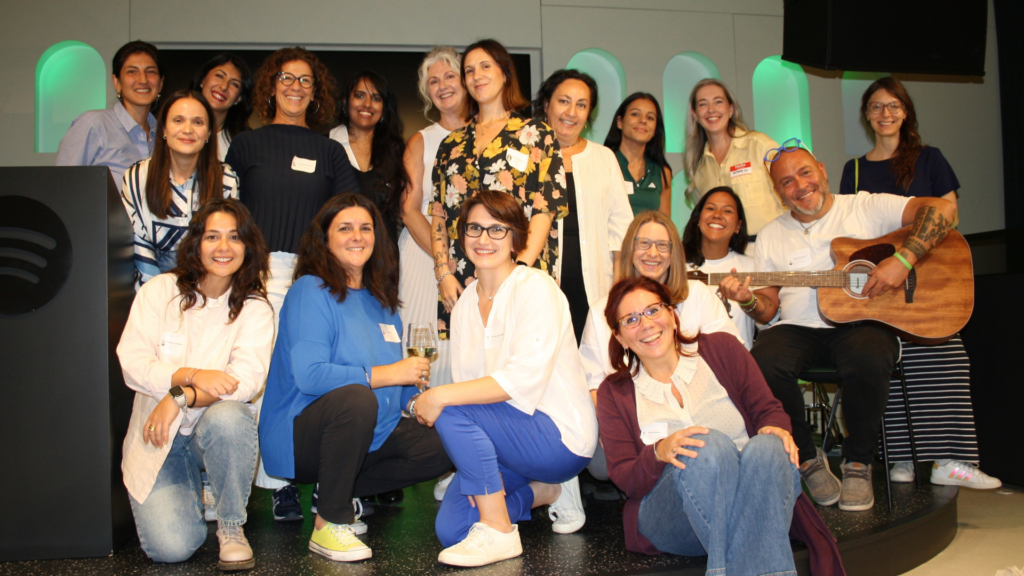
What happens when you put 15 localization leaders in one room, take away the stage, and simply let them talk?
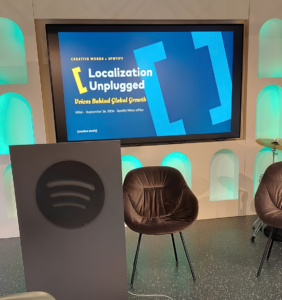
On September 24th, Creative Words and Spotify co-hosted Localization Unplugged — Voices Behind Global Growth at Spotify’s Milan office. The idea? Not a conference, and definitely not a sales pitch or a product demo. We kept the group small on purpose, so that everyone could take part rather than just sit and listen.
We opened with a few key findings from our Voice of the Localization Manager report: the trends, priorities and challenges that client-side localization leaders had shared with us. But the report was only a conversation starter. From there, the evening belonged to the people in the room, with peers from Italy and abroad comparing notes on what they actually live every day.
Candid conversations in a small room often offer more to take home than any keynote. Over two hours (and an aperitivo), two topics took most of the energy: what AI is really changing, and how to build localization KPIs that executives actually care about. Here is what emerged.
AI in real life: what works, what doesn’t, and where the limits are
What surprised us most was how quickly the conversation moved past language workflows. Yes, AI post-editing and AI-driven LQA are now part of daily life for most teams. But the real question in the room was a bigger one: how do we use AI not just to make localization faster, but to create more value through our work — and make the strategic value of localization more visible across the business?
Several participants are already using AI to support strategy and decisions, connect systems that never talked to each other, build dashboards, and turn scattered data into something leadership can read. Others are taking AI beyond language quality altogether, using it to understand markets better and to improve the user experience in each locale.
Three questions kept coming back:
- How do we measure the impact of the human in the loop? Without that, it is impossible to decide where budget should go and where people bring the most value.
- How do we make evaluation relevant and accurate? Who should evaluate AI output, and how? Nobody claimed to have the perfect answer, which was refreshingly honest.
- Who should be on the team? More and more localization teams include engineers and machine learning experts next to linguists and program managers.
Two more points stood out. First, needs differ enormously across organizations, so there is no single AI playbook to copy. Second, you don’t always need to build something new. Often the smarter move is to learn which tools already exist and help your team use them well.
The common thread: AI delivers real value only when human expertise and judgment guide it.
Proving value upstairs: localization KPIs and the case for executives
If the AI discussion was full of curiosity, this one was full of shared frustration. Many localization teams are judged on KPIs that sit far away from what they actually do. And the question everyone recognized was simple: how do we get in the room where decisions are made?
The answers that emerged were practical and concrete.
- Redefine quality.
We are already strong at language quality. But executives think about quality more broadly: user satisfaction, market performance, brand consistency. The opportunity is to widen how we define it, and how we talk about it. As one of the participants said, “We don’t need to be better at quality. We need to sell it better.”
-
Connect to customer success.
Several participants link user satisfaction scores directly to their localization strategy. When localization sits inside a larger team with shared goals, proving value becomes much easier.
-
Risk the language of risk.
Risk management resonates with the business in a way that error rates rarely do. A market launch that fails because of poor localization is a story every executive understands.
-
Speak different languages, literally and figuratively.
We are the people who speak different languages for a living, so we should be the best at adapting our message to each stakeholder. Finance, product, marketing and the C-suite each need a different framing of the same value.
-
Be the connector.
Sometimes the most valuable role is bringing departments together and getting teams to talk to each other. Localization touches almost every function in a company. That visibility is an asset. We can share our tools, data and metrics with other teams and build a reputation as a function that adds value everywhere.
The best practice mentioned most often combined solid numbers with the courage to challenge how things have always been done. And above all, the ability to adjust as the business changes.

The takeaway: fit into other people’s KPIs
To stay relevant, localization teams need to connect their work to broader business objectives and fit into other departments’ KPIs, not only their own.
That means communicating value in terms that resonate with each stakeholder. It means positioning ourselves beyond language quality alone. And, interestingly, it is exactly where AI can help most: not just translating faster, but giving us the data, dashboards and insights to tell a stronger story upstairs.
A huge thank you to Hilary and the Spotify team for opening their beautiful Milan office and believing in this format from day one, and to every participant for their honesty and generosity. You made the evening what it was.
We will definitely do this again. In the meantime, we would love to hear from you: how are you connecting localization to your company’s KPIs?
And if you’d like to see the full results of our Voice of the Localization Manager survey, get in touch and we’ll send them your way.